1. Executive plan
Domaine ILLIDGE delivers an integrated offer built on three pillars: agro-ecology & education, sustainable tourism (8 ecolodges), and family attractions (botanical & play park). The goal is to create a Caribbean flagship destination combining education, leisure, and sustainability anchored in short supply chains.
Key differentiators: farm + lodging mix, renewable energy (solar & biogas), short local chains, tailored offers for families/schools/businesses.
2. Infrastructure & capacities
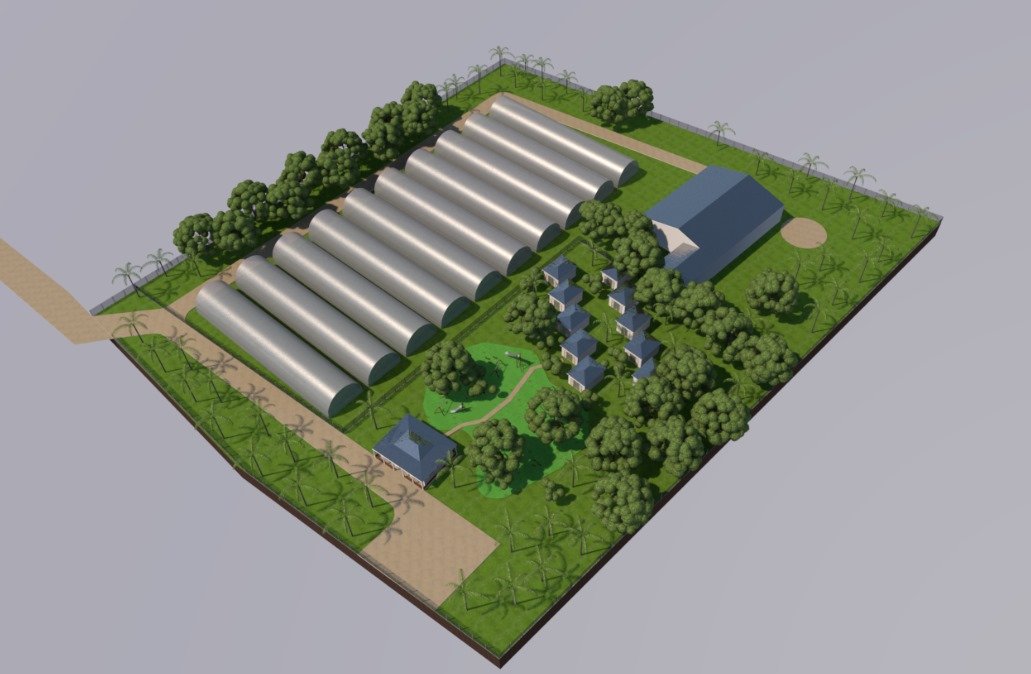
Synthesis based on the operational site plan and overall concept.
| Asset | Details | Area / Qty |
|---|---|---|
| Hydroponic greenhouses | Fruits & vegetables | 5 units (≈1,600 m²) |
| Aquaponic greenhouses | Fish farming + crops | 5 units (≈1,600 m²) |
| Total greenhouses | Hydroponics + aquaponics | 10 units (≈3,200 m²) |
| Processing warehouse | Sorting, packaging, light cold room; PV roof | ≈500 m² |
| Energy storage shed | Batteries / energy management | ≈80 m² |
| Ecolodges | Eco-designed bungalows | 8 units (≈20 m² footprint/unit) |
| Creole house | Visitor reception & farm shop | ≈90 m² footprint |
| Botanical & play park | Playground & learning trail | ≈2,000 m² (est.) |
| Animal areas | Goats, kids, chicken coops, beehives | ≈500 m² (est.) |
| Biogas | Buried digester – green waste → energy | Capacity sized to site |
| Parking | Visitor parking | ≈800 m² (est.) |
A 15-m non-buildable strip along the boundary is preserved and planted (fruit trees & coconut palms).
3. Positioning & strategy
Strategic axes
- Education: school & association workshops, guided tours.
- Sustainable tourism: immersive ecolodge stays.
- Local production: direct sales & partners.
- Events: team-building & seminars.
- Energy transition: solar + biogas.
Marketing
- Social content (animals/workshops/ecolodges).
- SEO + local campaigns (Search/Maps).
- Local press & hotel/agency partnerships.
- School programs & family bundles.
- Tired pricing (school, family, corporate packs).
4. SWOT analysis
Strengths
- Unique concept (farm + lodging + park).
- Integrated capacity (3,200 m² greenhouses).
- Short supply chains & pedagogy.
- Renewables (PV & biogas).
Weaknesses
- High upfront capex.
- Multi-skilled HR needs (agri, guest services, maintenance).
- Partial reliance on tourist flows.
Opportunities
- Growth in sustainable & educational tourism.
- Public funding (EU, ADEME, FEADER, local gov.).
- Partnerships with schools/NGOs/businesses.
Threats
- Climate/hurricane & sanitary risks.
- Variable economic context.
- Competition across leisure & lodging.
5. Segments & offers
| Segment | Needs | Dedicated offers |
|---|---|---|
| Schools | Discovery, educational content, safety | Themed workshops, class packs, group rates |
| Families & tourists | Nature experience, kids’ activities, lodging | Park tickets, guided tours, ecolodge nights, family bundles |
| Businesses | Team cohesion, inspiring setting | Team-building, seminars, private events |
| Associations | Preferential access, social impact | Solidarity pricing, themed days |
6. Business Model Canvas
Value proposition
- Sustainable, educational & family-friendly destination.
- Local farm products & short chains.
- Nature-immersive ecolodges.
Customer segments
- Schools & associations.
- Families & tourists.
- Enterprises (B2B).
Channels
- Website & social media.
- School & hotel partnerships.
- Tourist offices & DMO.
Customer relationships
- On-site reception & service.
- Community via social media.
- Feedback & continuous improvement.
Revenue streams
- Ecolodge nights.
- Tickets & workshops.
- Product sales (farm/partners).
- Events & venue hire.
Key resources
- Greenhouses, warehouses, ecolodges, park.
- Agri & guest services teams.
- PV + biogas energy.
Key activities
- Agri production (hydro/aqua).
- Educational hosting/animation.
- Lodging operations & retail.
Key partners
- Municipal & regional bodies, ADEME, FEADER.
- Associations, schools, travel agencies.
- Energy & agri suppliers.
Cost structure
- Capex: build & equipment.
- Salaries & maintenance.
- Energy & insurance.
- Marketing & distribution.
7. Timeline & milestones
| Phase | Deliverable | Target date |
|---|---|---|
| Permits & approvals | Building permit granted | Dec 2025 |
| Financing close | Bank & grant agreements | Jan 2026 |
| Works start | Notice to proceed | Feb 2026 |
| Initial hiring | Core team (agri/guest) | Apr 2026 |
| Pre-opening | Soft opening & tests | Jun 2026 |
| Opening | Public reception | Jul 2026 |
8. Investment plan (Capex estimates)
| Category | Amount (€) |
|---|---|
| Greenhouses (10 units) | 320,000 |
| Warehouses + equipment | 250,000 |
| Ecolodges (8 units) | 240,000 |
| Creole house & reception | 100,000 |
| Botanical & play park | 80,000 |
| Renewables (PV + biogas) | 70,000 |
| Animals & enclosures | 30,000 |
| Total investment | 1,090,000 |
Figures to be refined after quotes; phasing possible (greenhouses & park in tranche 1, ecolodges in tranche 2).
9. 3-year financial forecasts
| Year | Revenue (€) | Costs (€) | Net result (€) |
|---|---|---|---|
| Year 1 | 250,000 | 220,000 | 30,000 |
| Year 2 | 420,000 | 320,000 | 100,000 |
| Year 3 | 600,000 | 420,000 | 180,000 |
Key assumptions
- Ecolodge occupancy: 60% (Y1) → 75% (Y2) → 85% (Y3).
- Average nightly rate: €150 (family & B2B packs possible).
- Park ticket: €15/person – progressive ramp-up to 30,000 visitors in Y3.
- Workshops & product sales scale with partnerships.
Cash budget & working capital requirements will be added once quotes are consolidated (energy, cold chain, insurance, payroll).
10. Grants & subsidies (indicative)
- FEADER: innovative agriculture (hydroponics/aquaponics) & short chains.
- ADEME: renewables (PV), bio-waste to energy (biogas).
- FEDER/FSE+: eco-tourism infrastructure & educational programs.
- Local authorities: Region/Department/Intercommunal – tourism, education, transition.
- EU education programs: educational content & equipment.
Submission calendar aligned with project phasing and annual calls.
Sources
- Domaine ILLIDGE – Business Plan (project document).
- Site plan – Educational & ecological farm with ecolodges and kids’ park (Sept 2025).